天地男儿
China reports 522,000 new COVID-19 cases, one death in July amid fluctuating upward trend_我的网站

一 | 北京8月21日电 (记者 吕少威)“十五五”期间,北京市门头沟区从绿色发展、创新发展、协调发展、文旅融合、开放共享、安全稳定6大维度,设定32项指标、布局9个领域重点任务,谋划亿元以上项目百余个。

二 | 门头沟区区长吕鸣在21日于北京举行的新闻发布会上提到上述内容。

三 | 8月21日,北京市人民政府新闻办公室举行新闻发布会。

四 |

Photo: VCG
China reported 522,000 newly confirmed COVID-19 cases in July, including 487 severe cases and one related death with cases showing a fluctuating upward trend, China's national disease control authority said.
The current uptick in infections represents another regular cyclical wave, with its severity comparable to surges seen in the past two years. The upward growth curve has slowed markedly, and the country is now on the plateau phase of this epidemic peak, said the Chinese Center for Disease Control and Prevention (Chinese CDC) on Thursday.
All tested infection samples were confirmed to be the Omicron variant, with the NB.1.8.1 strain and its sublineages accounting for the majority of circulating cases, the Chinese CDC said.
A Beijing-based respiratory disease specialist told the Global Times that waning population immunity, continued virus mutations that weaken existing antibody protection, and increased summer travel have contributed to the recent modest rise in infections. However, there is no evidence that the virus has become more pathogenic. Nationwide infections appear to be nearing their peak and case numbers may begin falling in late August.
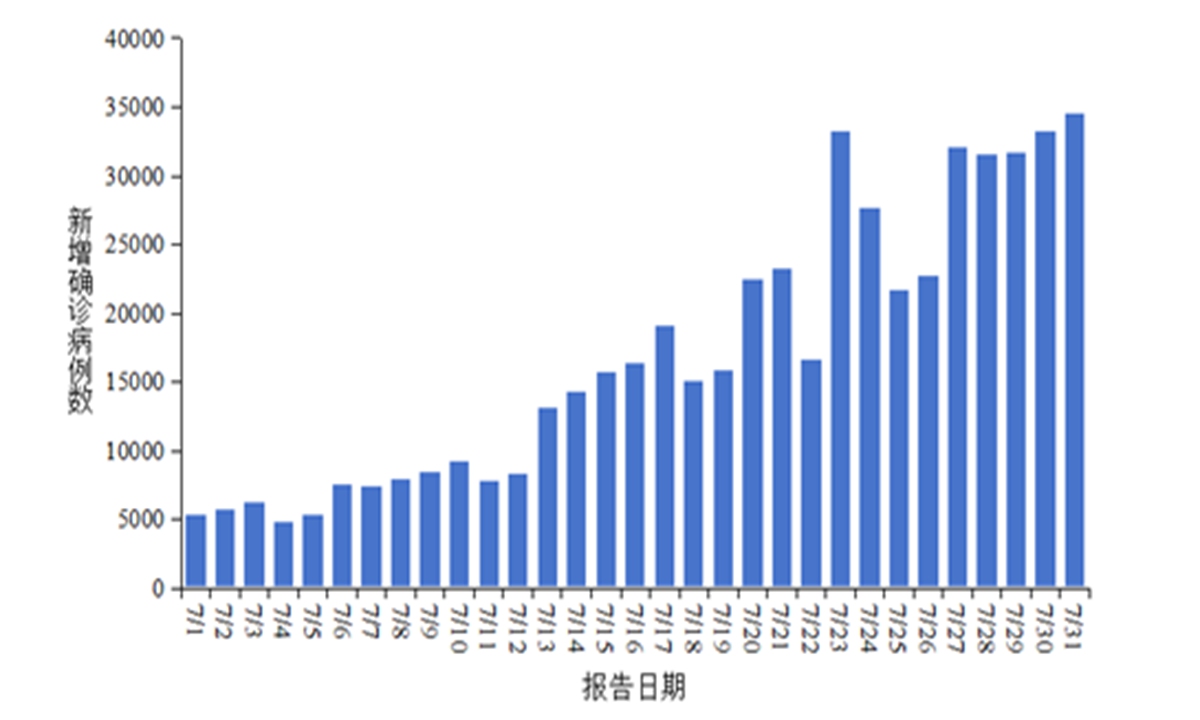
A screenshot from Chinese CDC report on new COVID-19 cases in July nationwide
According to sentinel hospital surveillance data, from June 29-July 5 to July 27-August 2, the proportion of influenza-like illness among all outpatient and emergency visits at China's 1,041 COVID-19 and influenza sentinel hospitals edged up with slight fluctuations, standing at 4.3 percent, 4.4 percent, 4.5 percent, 4.4 percent and 4.5 percent, respectively.
During the same period, the COVID-19 positivity rate among patients with influenza-like illness in outpatient and emergency departments rose for consecutive weeks.
Several factors drove the fluctuating rise in COVID-19 cases in July. Population immunity has waned, as more than six months have passed since the last major wave of infections for most people, while continued SARS-CoV-2 mutations have reduced the protection provided by existing antibodies, Li Tongzeng, a respiratory disease medic from Beijing You An Hospital to the Capital Medical University, told the Global Times on Friday.
These factors, combined with increased travel and population mobility during the summer vacation, contributed to the recent small-scale surge. Based on patterns observed in recent years, COVID-19 infections tend to rise every six to eight months as population immunity declines, said Li.
The expert noted that while the virus continues to mutate, there is no evidence that it has become more pathogenic. Clinical data show that most patients develop only mild symptoms, with very few progressing to pneumonia or requiring hospitalization.
The Chinese CDC noted on Thursday that since COVID-19 was reclassified as a Category B infectious disease under Category B management, it has evolved into a prevalent, recurring respiratory infectious disease in China, with one to two epidemic fluctuations occurring nationwide each year.
Li also noted that residual immunity from previous infections also helps reduce disease severity, with most reinfections presenting as mild upper respiratory symptoms that resolve within about a week. The single COVID-related death reported nationwide in July further indicates that the current fatality rate remains very low.
Judging from historical epidemic patterns and current case growth trajectories, national infection figures may begin to decline in late August. Nationwide case numbers are now nearly at their peak, with declines already observed in some regions, said Li.
The Chinese CDC also said on Thursday that surveillance had not detected any variants posing major public health risks, nor had the current wave caused notable disruptions to the healthcare system.
The public is advised to take appropriate protective measures, including wearing masks when necessary, maintaining good personal hygiene, adopting healthy lifestyles and getting vaccinated as recommended.
。李磊 摄 吕鸣介绍,“十五五”期间,门头沟区将一体推进“山水林田湖草沙”保护修复,加快太行山东北部综合治理、西山登峰揽胜森林步道以及灵山高山草甸生态修复。全面推进永定河山峡段、国道108、109以及六环路“一水三线”蓝绿空间风景廊道建设。高质量建设和管理百花山国家级自然保护区,持续开展“迎豹回家”行动,统筹生态保护、绿色发展和民生改善,全力争创世界生物圈保护区。 门头沟区将统筹推进永定河官厅山峡洪水控制、城区9闸1坝修复改造以及三家店地区山洪治理和排洪能力提升等重大工程。重点推进河滩路、石龙路、莲石湖西路跨河东延,以及军温路、军红路、吕北路等节点联通。

五 | 加快清水、小园、龙泉等消防站建设,新建多功能防火警示系统400套。深化人工智能等技术应用,建强“城市大脑”综合数据平台,数字化赋能基层治理。 在推进文商旅体融合发展方面,门头沟区将高品质建设“几字湾”生态湿地、永定楼文化湿地和门城湖环线 Citywalk特色线路,推动三家店百年桥墩和古渡口焕彩新生,修复提升三潭古道、玉河古道和西山大道,实现“蓝绿路视”互联互通。抓紧启动上岸渡滨水活力区建设,谋划推出“永定半岛”世界级城市水岸客厅。

六 | 门头沟区将实施京畿长城沿线修缮、京西古道全线提质工程和潭戒两寺整体风貌提升行动,打造全市首个古寺古村连片文旅融合示范片区,推动潭柘休闲旅游度假区晋级国家级,提升妙峰山、百花山、南石洋、爨柏等景区知名度和品牌影响力。

七 | 到“十五五”末,全区A级景区数量突破25处,4A级及以上景区超6处,到“十五五”末,旅游接待人次和综合收入实现翻番。 吕鸣表示,门头沟区将聚力培育新质生产力,高标准建设宜业新高地。

八 | 布局建设行业智算中心,推进珠窝、鲁家山等万P算力落地,构建“算法仓”,形成10个以上垂类应用模型,落地开源芯片与机器人融合创新中心。搭建视听内容发布传播平台,打造更多“视听+”标杆场景。接续实施“永定河畔微短剧共创计划”,聚焦精品漫剧、微短剧特色赛道,打造京西剧谷·叙事堂、AIGC创作基地、XR沉浸视听实验室、星野OPC社区等特色载体。 门头沟区还将发挥国家心血管病防治中心引领作用,依托阜外研究型医院和百洋生物医药科研与转化功能性平台,搭建临床研究、精密加工、CRO服务、市场转化的协同创新体系,加速推动新一代人工心脏、4π智能机器人放疗等创新药械产业化。推动中关村门头沟园向综合型未来科技小镇转型。建设石龙五期新型材料研发基地、创新药械制造基地,盘活存量厂房、低效楼宇打造新型智造空间。优化园区交通组织,提升道路通达性和出行便利度。实施人才安居计划,打造京西人才大厦和青年会客厅。
Current article:http://hp07hc.ningshunsaotuiqiao.shop/5h60b5/quev.html
Published on:13:06:13